
Table of contents
- Overview
- The Opportunity
- The Strategy
- Location pages at scale
- Proof instead of stock photos
- The Result
- Conclusion
Overview
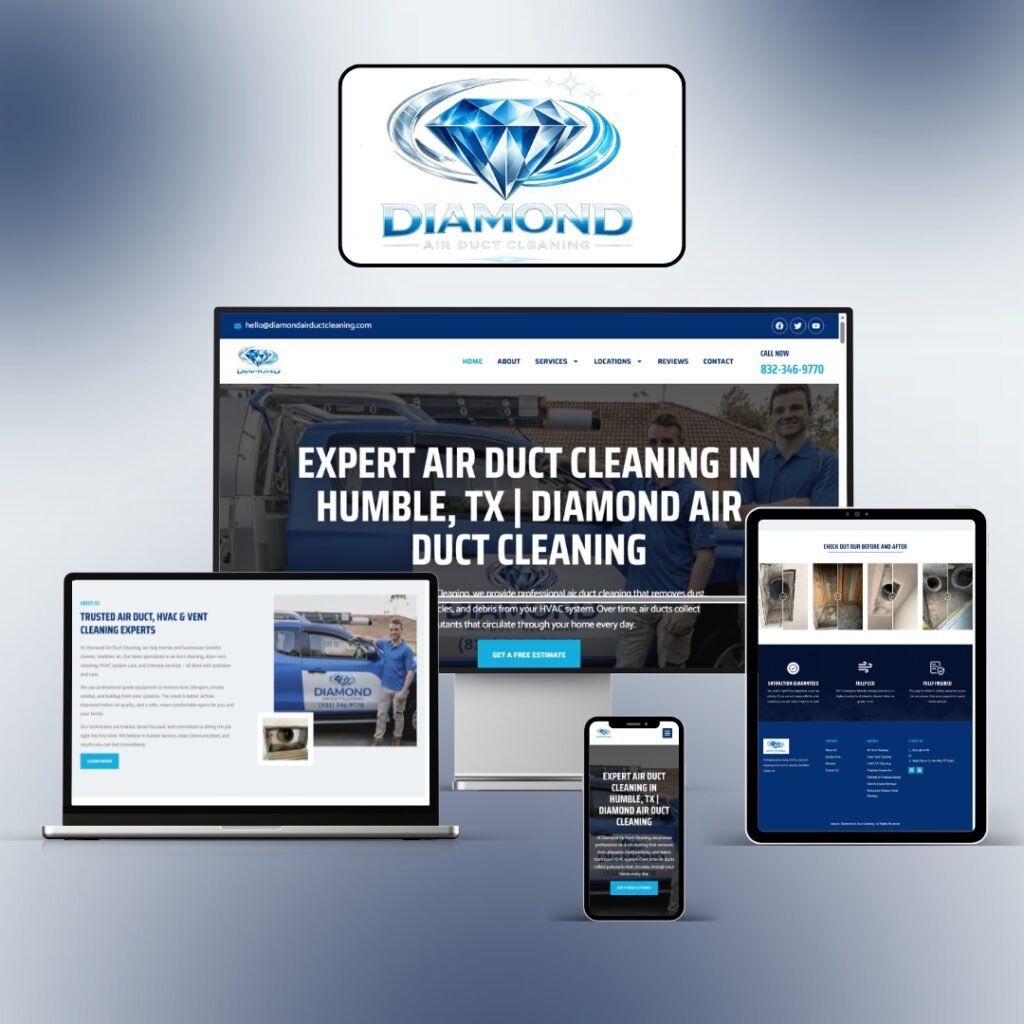
Diamond Air Duct Cleaning is an air duct and HVAC cleaning company operating across Houston, Texas. Jacob came to me needing a site that could compete for local searches across an entire metro area, not just the suburb the business happens to sit in.
The result was a 32-page WordPress build, of which more than 50 are location and service area pages.
What the project involved
- A 32-page custom WordPress build
- More than 50 location and service area pages
- Individual service pages for each type of job
- Before and after photography from real jobs
- Contact forms and Google Maps integration
- Mobile-first layout built around the phone call
The Opportunity
Houston is enormous. A homeowner in Katy searching for air duct cleaning does not search the same way as one in Sugar Land, and neither of them types the name of a company they have never heard of. They search for the service plus where they live.
A single page saying “serving the Houston area” does not compete for any of those searches. It is one page trying to rank for fifty different local intents, which means it ranks for none of them properly.
The opportunity was to give every area its own page, and every service its own page, so the site had something specific to offer each of those searches.
The Strategy
Two things decide whether a duct cleaning site earns its money: whether it turns up in the right local search, and whether the homeowner believes the company is real when they land on it.
So the build was structured around those two problems rather than around a design concept.
Location pages at scale
Fifty location pages is not fifty copies of the same page with the town name swapped. Each one needed to stand on its own or it is worth nothing.
I built the structure so each area page carries its own content, its own internal links back to the relevant services, and its own place in the sitemap. That is the mechanism behind local search visibility for a trades business, and it is the single biggest thing most contractor websites are missing.
Proof instead of stock photos
Duct cleaning is a service where the customer cannot see the problem and cannot easily verify the work. That makes proof the whole sale.
Rather than filling the site with stock images of smiling technicians, the build uses before and after photographs from Jacob’s actual jobs. A homeowner can see what the ducts looked like before and what they looked like after, which does more for conversion than any amount of copy.
Built for the phone
Contact forms and Google Maps are in place, but the layout assumes most people will call rather than fill anything in. The number stays within reach throughout, and the pages are built mobile-first because that is where the searches happen.
The Result
A 32-page site with more than 50 location pages behind it, covering the Houston metro rather than one corner of it. Jacob’s reaction was about the thing I was most trying to get right:
“Most importantly it doesn’t look generic.”
— Jacob, Diamond Air Duct Cleaning, Houston, Texas
Conclusion
Location pages are unglamorous work. They are also the difference between showing up for one search and showing up for fifty, which is why this build is the one I point HVAC companies at when they ask what a serious local site looks like.
If you run an HVAC company in Houston, the HVAC website design Houston page explains how I would approach your site. There is also a version for HVAC companies in Austin.
Want something similar? Get a quote.