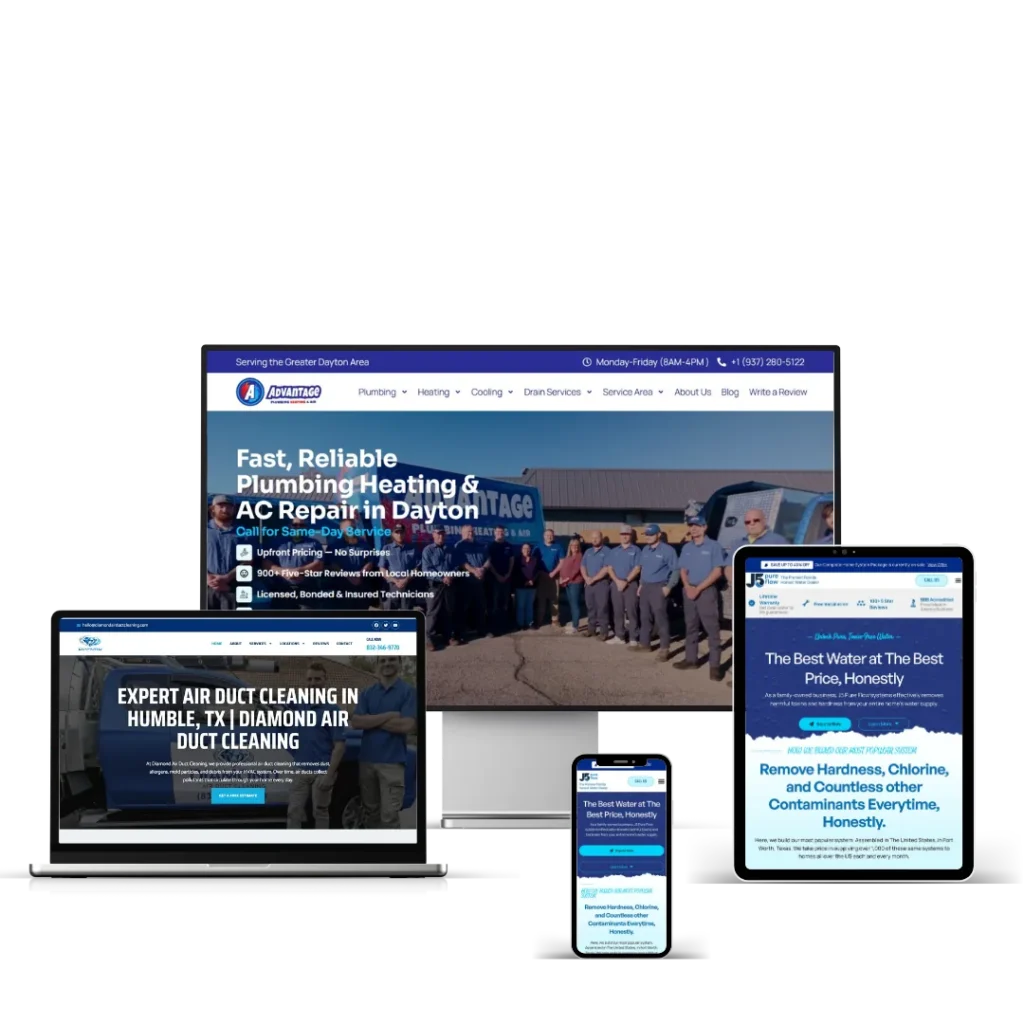

HVAC SEO is the work of getting a heating and cooling company to show up when someone in your service area searches for a repair. It is not one job. It is a Google Business Profile that is filled in properly, a page for each service you sell, a page for each town you cover, and a site fast enough to load on a phone in a hot attic.
This guide is for owners of HVAC companies who are paying for SEO and cannot tell what they are getting, or who are about to start and want to know what the work actually is. I build and rank WordPress sites for trades businesses, so I will be specific about what moves the needle and what does not.
The short answer
- Your Google Business Profile does more for emergency calls than your website does. Fix it first, and it is free.
- One page per service, one page per town. Most HVAC sites fail here and nowhere else.
- Reviews are a ranking factor and a conversion factor at the same time. Ask for them after every job.
- Judge an SEO agency on booked calls, not on rankings or traffic.
Start with your Google Business Profile, not your website
For a homeowner with no heat, the map pack at the top of the results gets the click. Google says local results are based mainly on relevance, distance and prominence (Tips to improve your local ranking on Google). You cannot change distance. You can change the other two.
- Pick the most specific primary category, usually HVAC Contractor, and add secondary categories for the work you actually do.
- Set a service area that matches where you really drive, not a hopeful radius covering three counties.
- List every service separately rather than writing “heating and cooling”.
- Put real photos of your vans, team and finished jobs in, and keep adding them.
- Answer every review, including the bad ones, in plain language.
This is the highest-return hour you will spend, and no agency needs to do it for you.
A page for every service
Most HVAC company SEO work breaks down on this one point, and SEO for HVAC companies rarely recovers without fixing it. A homeowner searching for furnace repair wants a page about furnace repair, not a line item on a services list. Each of these deserves its own page:
- AC repair and AC installation, as two separate pages
- Furnace repair and furnace installation
- Heat pump install and service
- Emergency and after-hours repair
- Maintenance plans and tune-ups
- Duct cleaning and duct sealing
- Indoor air quality
- Commercial work, if you take it
Each page should say which systems and brands you work on, whether you take emergency calls, how fast you can realistically get there, and roughly what affects the price. Write what you would tell someone on the phone.
A page for every town you cover
If your office sits in one suburb and you cover twenty, a single page can only ever be relevant to a small slice of those searches. One page per area fixes that, and it is the single biggest structural change most HVAC sites need.
When I built the site for Diamond Air Duct Cleaning in Houston, it became a 32-page build with more than 50 location pages behind it, so the business turns up across the metro instead of in one suburb. I plan the same structure for HVAC companies in Houston and HVAC companies in Austin.
The warning that comes with this: a location page that is your service page with the town name swapped in is a doorway page, and Google is explicit that those are against its spam policies. A real location page names the neighbourhoods, mentions local jobs you have done, and gives the response time for that area.
Reviews do two jobs at once
Reviews feed the prominence signal that decides map pack order, and they are also the thing a homeowner reads before calling. Ask at the end of every job, while the house is warm again and the customer is pleased. A tech with a QR code on a card gets more reviews than an email sent three days later.
Put them on the site too, with the customer’s first name and town, not as anonymous five-star quotes.
Speed, phones and the call button
HVAC searches spike in a heatwave or a cold snap, on phones, often outdoors. Google measures real loading behaviour through Core Web Vitals (web.dev). Test with PageSpeed Insights on a phone, not on the office desktop.
HVAC website SEO is wasted if the call is hard to make. Your number belongs in the header as a tap-to-call link, visible without scrolling. A contact form is fine for a quote on a new system. Nobody fills in a form when the house is 95 degrees.
The technical part, kept short
- Add LocalBusiness schema with your name, address, phone and service area (Google’s documentation).
- Make sure your name, address and phone are written identically everywhere they appear online.
- Check the site is not set to discourage search engines. A leftover noindex is the most common reason a new HVAC site never appears at all.
- If you rebuild, map a 301 redirect from every old address to its new one (Redirects and Google Search).
- Submit your sitemap in Google Search Console and look at the Pages report once a month.
What HVAC SEO services should cost, and what to ask
Pricing varies widely, and HVAC keywords are among the most expensive in local search, so anyone selling SEO services for HVAC companies knows exactly what a booked job is worth to you. Before you sign anything, ask:
- Which pages will you build or rewrite in the first 90 days?
- Will I own the website and the content if I leave?
- How will you report booked calls, not just rankings and traffic?
- Who writes the location pages, and how do you keep them from being near-duplicates?
- What happens to my Google Business Profile access when the contract ends?
Any good answer to question three involves call tracking. Rankings move for reasons nobody controls. Calls are the only number that pays wages.
A realistic order of work
- Week one. Google Business Profile filled in properly. Review requests started.
- Weeks two to six. One page per service, written properly.
- Weeks six to twelve. One page per town, starting with the areas you most want more work in.
- Ongoing. Reviews, photos, speed, and a new page whenever you add a service or an area.
You will usually see map pack movement inside a month or two because the profile work is fast. Organic rankings for service and location pages take longer, generally three to six months, and longer again in a competitive metro.
Frequently asked questions
How long does HVAC SEO take to work?
Google Business Profile changes can show within weeks. Service and location pages usually take three to six months to settle, and longer in a big metro with established competitors. Anyone promising page one in 30 days is selling you something else.
Is HVAC SEO worth it for a one-van company?
Yes, but narrow it. One van covering one town needs a strong Google Business Profile, a handful of real service pages and reviews. It does not need fifty location pages. The structure should match the size of the area you can actually serve.
Do I need to blog for HVAC SEO?
Not at first. Service pages and location pages earn the calls. Blog posts help later, mostly by answering the questions homeowners ask before they buy, such as repair-or-replace and what a new system costs.
Should I hire someone local when I search “seo services for hvac companies near me”?
Local is not required. Your Google Business Profile and your pages are what rank, and neither cares where the person editing them sits. What matters is whether they have ranked trades sites before and whether you own everything when the contract ends.
What is the difference between HVAC SEO and Google Ads?
Ads stop the day you stop paying. SEO compounds and keeps working, but takes months to start. Most companies that can afford both run ads for emergency work while the SEO builds.
Want someone to do this for you?
I build WordPress sites for HVAC and plumbing companies with the service pages, location pages and speed work described above already in place. Starter builds are $800 for up to 5 pages, Business builds $1,400 for up to 10 pages, and sites with many location pages are quoted per project. Everything is on the pricing page.
Call +1 (239) 799-3971 or get a quote. You can also read how I approach SEO and AEO, HVAC website design, the Austin version of it, and the HVAC and plumbing businesses I work with. If roofing is also part of your business, the same structure applies — see roofing website SEO.